Lights
Lighting that follows daylight
The more sun comes in, the fewer lights are on. Without touching a switch.
The consumption of each tenant and of the shared areas, separated without entering the units: the evidence for BREEAM In-Use and what the EPBD requires. And, with a meter for each unit, rebilling nobody disputes.
Owners, asset and property managers of shopping centres and retail parks, and the BREEAM assessors who certify them.
To certify and to recharge, you have to separate each retail tenant's consumption from that of the shared areas. Conventional sub-metering means entering every unit, and splitting by floor area or spreadsheet ends in disputes with tenants.
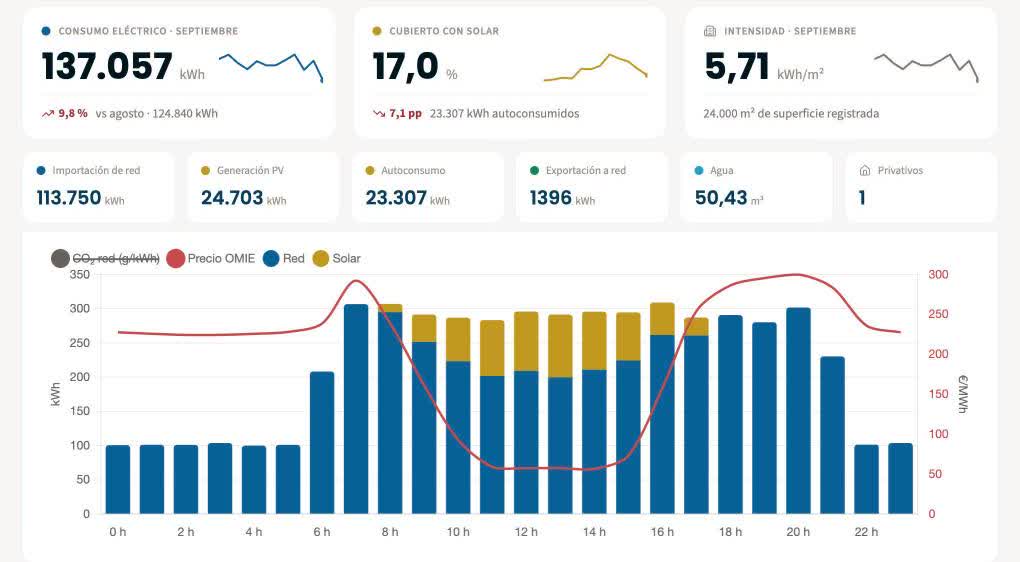
Every consumption metered, allocated and stored: the evidence for BREEAM In-Use, what the EPBD requires and recharging, all from the same data.
Energy efficiency in a shopping centre starts with knowing what each unit and each shared area consumes. In retail we do one thing: meter the building to certify it, comply with regulations and allocate consumption.
With sensors on the main meter and the sub-meters, we separate the consumption of shared areas and units by derived consumption, without installing a meter in each unit or asking tenants for access. It covers the Part 1 monitoring and the Part 2 consumption data throughout the certificate's three years.
The directive requires consumption to be recorded, analysed and controlled continuously in a large share of non-residential buildings; in Spain, for now, only automation for buildings over 290 kW is in force (RITE, Royal Decree 178/2021) and the rest depends on transposition. The Alfred gateway reads the BMS and the meters the centre already has and send the data to our cloud, with history, alarms and reports.
Each tenant pays for what they consume: their meter reading, at the real tariff, stored in a closed period that can't be altered afterwards and can be audited. To rebill, each unit needs its own meter: if it already has one, we read it; if not, one is added.
We read the existing meters with our own gateway and cloud, and the BMS through the Alfred gateway, via BACnet, Modbus or KNX. What's different is that we meter each unit, apply the real tariff and store every reading in a locked, auditable period.
A unit that barely uses anything pays the same as one with the air conditioning on all day.
With Alfred, each tenant pays for their metered consumption.
Manual readings, copying errors and months of delay.
With Alfred, automatic readings with the real tariff applied.
It runs the building systems, but it doesn't bill.
With Alfred, its data becomes a statement per tenant.
Twelve data points a year, for the whole centre.
With Alfred, continuous series by unit and by shared area, with alarms when something exceeds the threshold.
Metrics rebilling applies the tiered tariffs for each period and generates PDF bills, the rent roll, the SEPA direct-debit file and the Excel for your accounts. The same data provides the evidence for BREEAM In-Use and the EPBD reports.
How to start: a pilot in an operating centre that needs BREEAM In-Use certification or rebilling, then replicated across the portfolio.
Not for BREEAM In-Use: we separate the consumption of the units and the shared areas using the main meter and the sub-meters, without asking tenants for access.
There's no need to close, and the infrastructure is minimal: radio sensors on the main meter and the sub-meters, installed with the centre open. If a new meter is needed for rebilling, we'll look at it during the technical visit.
No. The Alfred gateway reads it via BACnet, Modbus or KNX, and our team checks every day that the data is arriving. The BMS still runs the building systems; we add metering, allocation and reports.
Their meter reading and the real tariff for the period. Each period is closed and locked, so the statement can be audited and doesn't change afterwards. During the technical visit we see what meters the centre has and what can be read.
It depends on the building's use and the output of its HVAC and ventilation. The final thresholds are set by the Spanish law transposing the directive. The EPBD checker gives you an initial answer in a few seconds.
You assess and we generate the monitoring evidence. We explain it on the page for consultants and engineering firms.
Tell us how many units it has and whether you want to certify, comply with the EPBD or recharge.