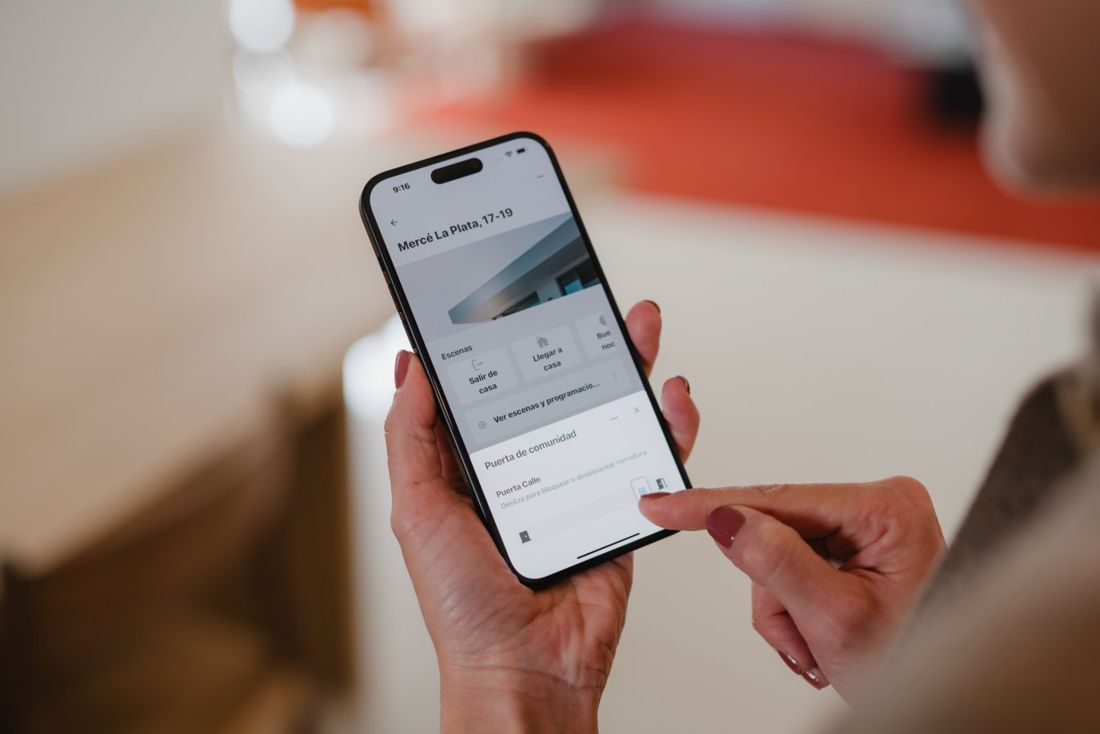
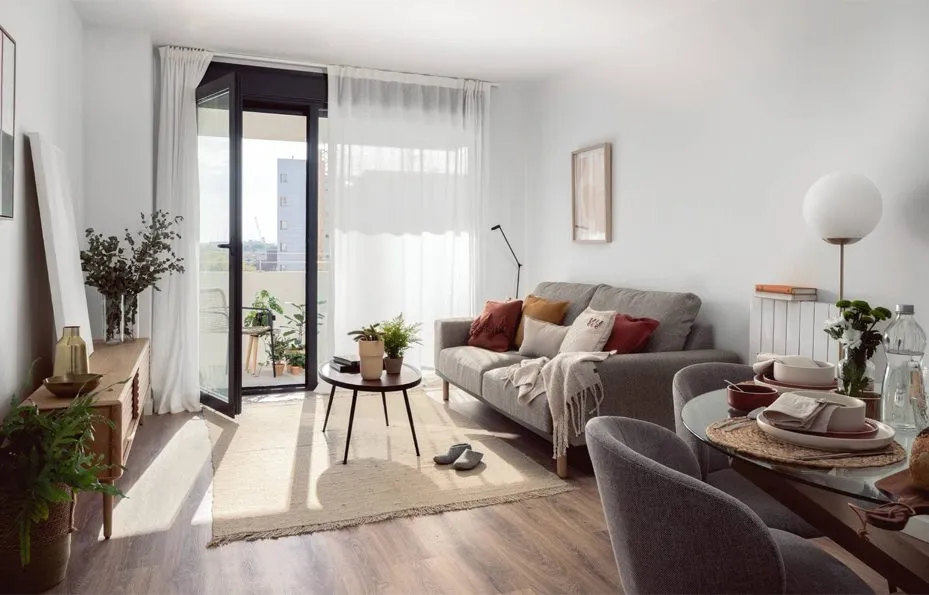
 Build-to-Rent · Barcelona
Vila Bonaplata
68 homes rated BREEAM Very Good.
No BREEAM ES Vivienda requirement awards points for installing a building management system. What Very Good does require is measuring temperature and consumption in every home and showing them in real time in an app.
We have reviewed every requirement in the scheme. The building management system (BMS) appears twice, and neither earns points.
In no requirement of the scheme and at no rating level.
That's the extra cost of a BMS in the shared areas of a development, compared with metering them without one.
SYB 12 Smart homes. Required from Very Good, and it does not ask for a BMS.
The BMS appears as something to be commissioned if specified, and as an example of a complex system. Not a single point is linked to installing it.
If specified, GST 04 requires commissioning procedures specific to the BMS. In GST 05, a minimum at Excellent and Outstanding, it counts as a complex system and may require a Commissioning Specialist.
The RITE (Spain's Regulation on Thermal Installations in Buildings) only requires automation and control systems in non-residential buildings over 290 kW. Of residential buildings it says they “may be equipped”.
What must be met no matter what at each rating, on top of reaching the minimum score. Of the fifteen minimums across the three ratings, only SYB 12 depends on technology; the other credits come from the design, the conventional installation or the documentation.
| Requirement | What it is | Very Good ≥ 55 % | Excellent ≥ 70 % | Outstanding ≥ 85 % | What you need to install |
|---|---|---|---|---|---|
| GST 03 | Responsible construction practices | — | 1 point | 2 points | Documentation and process |
| GST 04 | Home user guide (criterion 10) | Mandatory | Mandatory | Mandatory | Documentation and process |
| GST 05 | Periodic commissioning | — | 1 point | 1 point | Documentation and process |
| SYB 01 | High-frequency ballasts (criterion 1) | Mandatory | Mandatory | Mandatory | Conventional installation |
| SYB 06 | Inclusive and accessible design | — | — | 2 points | Project design |
| SYB 08 | Recreational space | — | 1 point | 1 point | Project design |
| SYB 09 | Water contamination risk | 1 point | 1 point | 1 point | Conventional installation |
| SYB 11 | Security | — | — | 1 point | Project design |
| SYB 12 | Smart homes | 1 point | 1 point | 1 point | Sensors and an app or display |
| ENE 01 | Reduction of energy use and emissions | — | 4 points | 6 points | Project design |
| AG 01 | Water consumption | 1 point | 1 point | 2 points | Conventional installation |
| AG 04 | Irrigation demand | — | 1 point | 1 point | Conventional installation |
| MAT 03 | Legal timber (criterion 1) | Mandatory | Mandatory | Mandatory | Documentation and process |
| RSD 01 | Construction and demolition waste | — | — | 1 point | Documentation and process |
| RSD 03 | Household waste | — | 1 point | 1 point | Project design |
“—”: not a minimum at that rating, although it can add points. BMS required at any rating: none. The ENE 01 points come from the project's energy model, not from a BMS.
It is a minimum from Very Good and sits entirely within the home. The point you need, the one for a basic smart home, requires these four criteria.
| Criterion | What it requires | Does a conventional installation provide it? | How Alfred Smart covers it |
|---|---|---|---|
| 1 · Temperature | Sensors that monitor the indoor temperature of the main rooms and the outdoor temperature. | No. The thermostatic valve required by the RITE regulates the emitter, but it does not measure or record. | A connected thermostat and temperature and humidity sensors in every home, plus an outdoor sensor. |
| 2 · Consumption | Sensors that monitor electricity and fuel consumption, and water consumption. | Partly. The meters exist, but they are billing meters or read periodically and do not give real-time data. | An energy meter in the home and readings from the water meters and, if there is one, the heat meter. |
| 3 · Connectivity | Broadband of over 24 Mb/s and 3G, 4G or 5G coverage indoors. | Yes. The building provides it; it only needs to be documented. | Nothing to install: it is documented on site with the network operators’ coverage maps. |
| 4 · App or display | Show indoor and outdoor temperature and consumption in real time, and control the temperature remotely. | No. It is the data layer. | The Alfred Smart app for whoever lives in the home, with climate and consumption. |
The main rooms are the living room, dining room and main bedroom (note NA07). Below 90 m², one sensor in the living room is enough; from 90 m² upwards, all three need one. A single thermostat per home does not meet criterion 1 in large layouts.
No history or downloadable reports (criterion 10a, third point), no CO₂, humidity or lighting (criteria 6 and 7, second point), and no storing 12 months of data (GST 05, which is not a minimum at Very Good). Note NA08 allows one app for temperature and another for consumption.
Criterion 4 requires an app or a display, so the data layer is essential at Very Good. What you don't need is the building management system. They are two different things and it is best not to mix them up at the project meeting.
When there is centralised generation and shared areas with plant to manage, the BMS is justified by operations. What makes no sense is carrying one over when generation is individual, as it is in most residential buildings.
Royal Decree 736/2020 on individual metering does not apply. The fuel consumption in criterion 2 comes from the home's gas meter; with a heat pump, it is all electricity consumption. There is no central plant to manage: a BMS adds no points.
Royal Decree 736/2020 requires every home to be metered with remote reading, and that data feeds criterion 2 of SYB 12. A BMS may be justified to run the central plant. If there is one, the Alfred platform gateway reads it via KNX, Modbus or BACnet: one app and one dashboard.
One gateway per home receives the data from the thermostat, sensors, energy meter and meters by radio. Nothing is installed in the shared areas.
The same inside the home, plus a LoRa transmitter on each meter and a LoRa gateway for the building. Readings arrive by radio, with no cabling.
The BMS still runs the central plant, pumping and ventilation. The Alfred platform gateway reads its data and Metrics combines it with the data from the homes.
In all three, the home meets SYB 12 in the same way. Residents see it in the app; the building manager and the BREEAM assessor see consumption and comfort for the whole building in Metrics.
One sheet per rating with the Table 3 minimums, the evidence each requirement asks for at design and post-construction stage, and which part the project's conventional installation already covers. We send it to you by email.
As a BREEAM partner, we have supported more than 5,000 homes rated at least BREEAM Very Good. Three of the developments:
Build-to-Rent · Barcelona68 homes rated BREEAM Very Good.
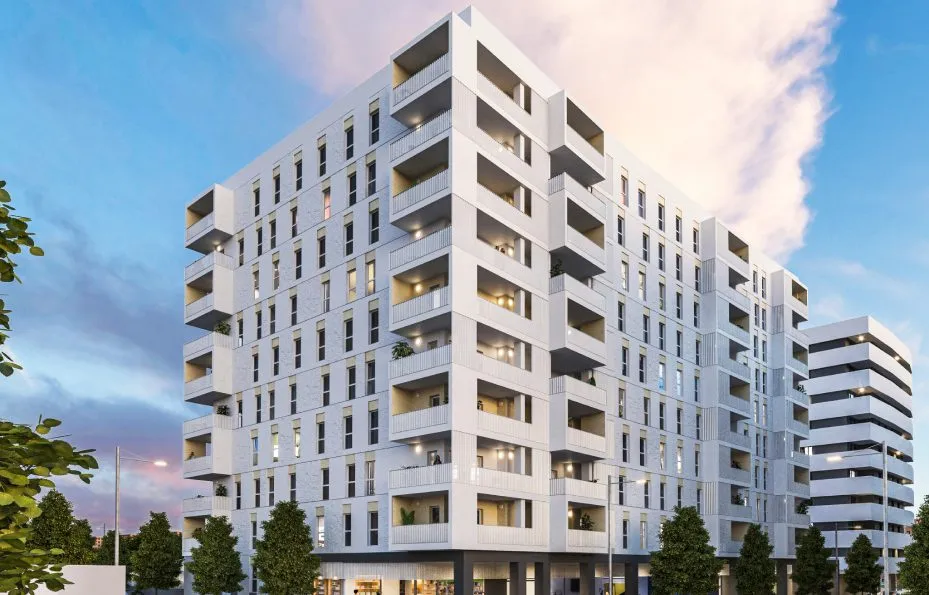 Residential · Seville
82 homes rated BREEAM Very Good.
59 homes rated BREEAM Very Good.
For the developer's technical or sustainability team: we review the project with you and tell you which architecture fits it and what SYB 12 requires for your home types.
No. No BREEAM ES Vivienda V6 requirement awards points for installing one, and Table 3 does not require it at any rating. What is a minimum from Very Good is SYB 12: measuring temperature and consumption and showing them in an app or a display.
Only in homes under 90 m², where note NA07 allows the temperature sensor in the living room only. From 90 m² upwards, sensors are needed in the living room, dining room and main bedroom, as well as the outdoor temperature.
Not at Very Good. Criterion 4 of SYB 12 asks for real time. The 12 months of data are in GST 05, which is only a minimum at Excellent and Outstanding, and there the required point is the one for periodic commissioning.
Royal Decree 736/2020 already requires every home to be metered with remote reading, so part of the metering is required by law anyway. If the building has a BMS to run the central plant, the Alfred platform gateway reads it via KNX, Modbus or BACnet, and the data from the homes and the plant end up in the same app.
The project's BREEAM assessor, using the current manual, and BREEAM ES verifies them. Alfred Smart does not issue certifications: we provide the installation and the evidence each criterion asks for.
We give you the SYB 12 evidence ready for your report, and the same data works for BREEAM In-Use and the EPBD.
References to the BREEAM ES Vivienda V6 Technical Manual, IPC-BREEAM-01-04-2020, edition 02 of 2 August 2024 (Table 3 and requirements GST 04, GST 05 and SYB 12), to the RITE (RD 1027/2007, amended by RD 178/2021) and to Royal Decree 736/2020. BREEAM® is a registered trademark of BRE. Do you have a development at design stage? Review it with our team.