Lights
Lighting that follows daylight
The more sun comes in, the fewer lights are on. Without touching a switch.
Directive (EU) 2024/1275 requires many buildings to monitor and control their energy. In Spain, for now, only automation for non-residential buildings over 290 kW (RITE) is in force. Check in 10 seconds what may apply to you.
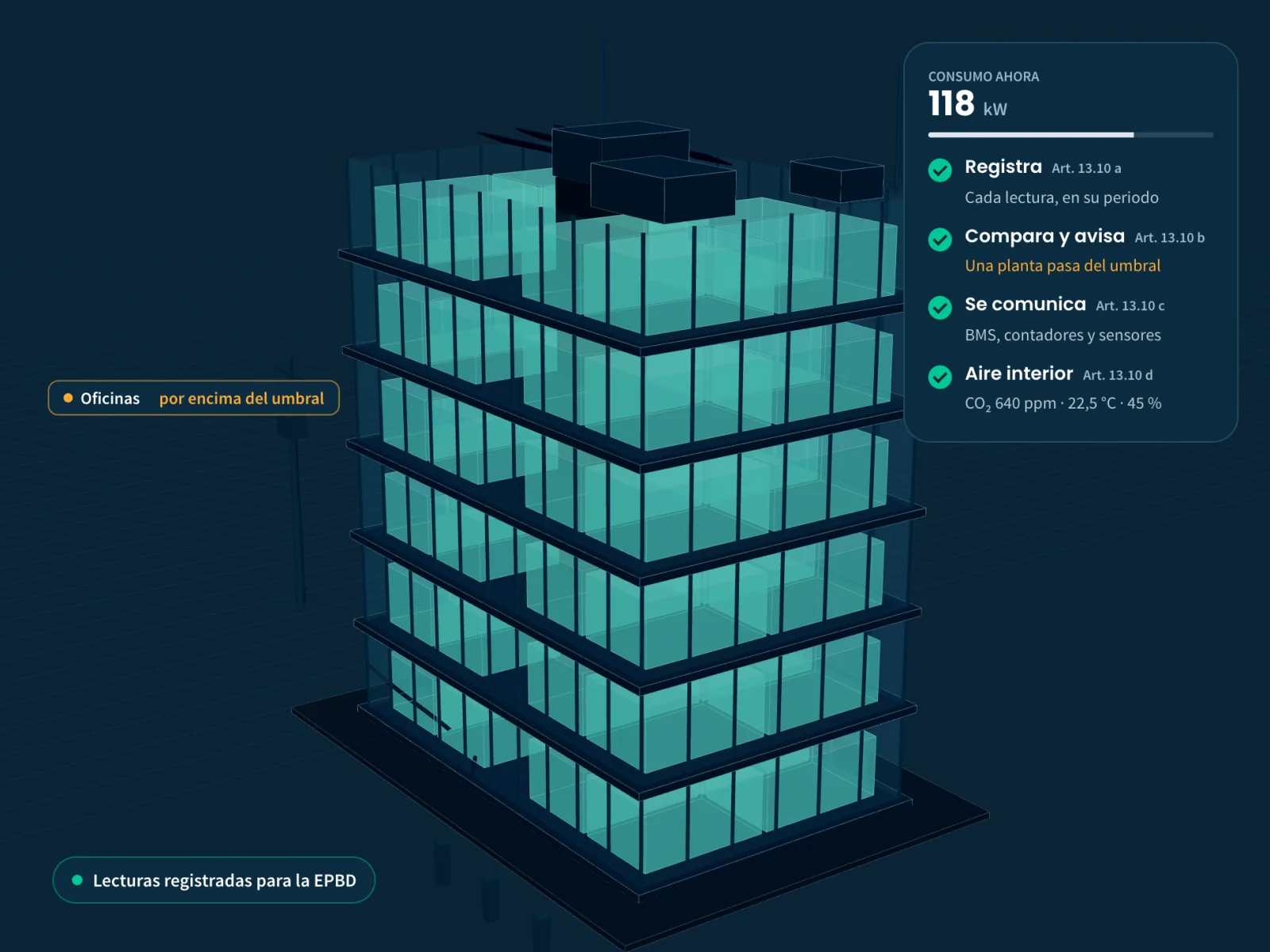
The EPBD (Energy Performance of Buildings Directive) is the European directive on the energy performance of buildings. Its current version, Directive (EU) 2024/1275, was published on 8 May 2024 and replaces the 2010 directive from 30 May 2026. Its goal is a zero-emission building stock by 2050, and to get there it sets intermediate steps: zero-emission new buildings, minimum efficiency standards for non-residential buildings and, what changes a manager's day-to-day work the most, continuous energy metering and control. Each obligation reaches the building when Spanish law incorporates it.
Non-residential buildings with higher heating, cooling or ventilation output need a building automation and control system (BACS) that records, analyses and adjusts consumption. Above 290 kW, the RITE already requires it.
The directive requires new homes and homes undergoing major renovation to be able to monitor their systems and alert when something deviates; in non-residential buildings, indoor air quality too. In Spain it will arrive with transposition.
The directive provides for each country to set a consumption threshold for non-residential buildings: the least efficient 16% of the stock would have to fall below it by 2030, and 26% by 2033. When Spain sets the threshold, you'll know whether it affects you.
Automation (BACS) is for non-residential buildings with high heating, cooling or ventilation output. In new homes, the directive requires the installations to be monitored, and in rental housing the same data is used to split consumption. In Spain, only BACS above 290 kW is mandatory today; the rest will come with transposition.
BACS if heating, cooling or ventilation exceeds 290 kW. With transposition, also indoor air and occupancy-based lighting.
See offices → BACS · non-residentialBACS in the centres with the highest output. And the same measured data is used to split consumption between tenants.
See retail → BACS · non-residentialBACS in warehouses with heating, cooling or ventilation above 290 kW, and consumption measured by meter and by tenant.
See industrial → BACS · non-residentialBACS based on heating, cooling and ventilation output, and indoor air monitoring once Spanish law provides for it.
See hotels → Sub-metering and rebillingThe monitoring of new homes required by the directive, and each home's consumption measured so it can be rebilled.
See Build-to-Rent → Sub-metering and rebillingThe consumption of each room or studio measured, to allocate it with allowances and prove what the building uses.
See flex living →The directive binds Member States, not owners directly: each obligation reaches the building once Spanish law provides for it. The automation obligation above 290 kW has been in the RITE since 2021; the rest depends on transposition, which Spain had to complete by 29 May 2026 and which, as of 13 November 2026, has still not been published in the BOE.
| Article | What it requires | Who | Directive date | In Spain | With Alfred |
|---|---|---|---|---|---|
| Art. 13(9)(a) | Building automation and control system (BACS) | Non-residential with heating, cooling or ventilation over 290 kW | 31 Dec 2024 | In force: RITE, amended by Royal Decree 178/2021 (existing buildings, by 2025 at the latest) | Metrics records and analyses; the BMS handles control |
| Art. 13(9)(b) | Building automation and control system (BACS) | Non-residential over 70 kW | 31 Dec 2029 | Pending transposition | Metrics records and analyses; the BMS handles control |
| Art. 13(10) | The BACS must continuously log and analyse energy use, benchmark efficiency, detect losses and communicate with other equipment | The same buildings | With the BACS | In force for over 290 kW (RITE) | Metrics records, compares and alerts by threshold |
| Art. 13(10)(d) | The BACS must monitor indoor environmental quality | The same buildings | 29 May 2026 | Pending transposition | Metrics (CO₂, temperature and humidity) |
| Art. 13(11) | Continuous electronic monitoring of technical systems, control and response to external signals | New residential and major renovations | 29 May 2026 | Pending transposition | Metrics |
| Art. 13(12) | Automatic lighting control with occupancy detection | Non-residential over 290 kW / over 70 kW | 31 Dec 2027 / 31 Dec 2029 | Pending transposition | Climate, lighting and access (offices); Metrics does not regulate |
| Art. 9(1) | Not exceeding the threshold of the worst-performing 16% / 26% of the stock | Non-residential buildings | 2030 / 2033 | Pending: Spain sets the threshold | Metrics: the measured consumption of each building |
| Art. 9.2 | National trajectory: −16% in the average primary energy of the residential stock | Residential stock | 2030 | Pending: set out in the Spanish plan | Metrics: the measured consumption of each home |
| Art. 7 | New zero-emission buildings | Public / all | 1 Jan 2028 / 1 Jan 2030 | In progress: the amendment of the Technical Building Code went out to public consultation on 7 Nov 2025 and has not yet been published in the BOE | Metrics measures actual consumption from handover |
| Art. 12 | Renovation passport scheme, voluntary | Owners who want to renovate | 29 May 2026 | Pending transposition | Metrics history as the starting point |
In the Metrics dimensions: consumption responds to Articles 13.10 a and b and 13.11; environment, to 13.10 d; and usage (occupancy and kWh per person) supports 13.12, although detecting occupancy and adjusting lighting is done by climate, lighting and access. The four dimensions, in Metrics.
Sources, consulted on 13 November 2026: text of Directive (EU) 2024/1275 (Articles 7, 9, 12, 13 and 35); Royal Decree 178/2021, which amends the RITE (IT 1.2.4.3.5 and third additional provision); the public consultation on the amendment of the Technical Building Code, which transposes part of the directive, and the prior public consultation on the amendment of the RITE (27 March 2025), and the consolidated texts of the Technical Building Code and the RITE in the BOE. When the Spanish legislation is published, we will update this table.
The directive doesn't require a specific device, but a set of capabilities. Metrics provides recording, comparing and alerting, with its own gateway and cloud; the BMS adjusts the equipment. It reads the existing meters and probes, receives BMS data through the Alfred platform gateway (BACnet, Modbus or KNX) and, where data is missing, adds meters or sensors with minimal infrastructure.
Every electricity, water and HVAC reading from the connected points is stored in its period and is fully traceable. Our team checks every day that the data is arriving.
The multi-asset view compares buildings and periods, and alarms notify you, by email and in the app, when consumption exceeds the threshold you set. With reports in PDF, Excel or CSV for whoever manages the building, the tenant or the investor, and a read-only link that expires after 30 days.
We are hardware-agnostic: the Alfred platform gateway connects to what the building already has (BMS, meters, Modbus, BACnet, KNX or LoRa). And if needed, we supply the equipment, the integration and the maintenance.
CO₂, temperature and humidity probes by zone, on the same screen as consumption.
Metering by home and by supply, with alerts to the manager when consumption exceeds the threshold they set. The same data is used for rebilling.
We audit the data coming from the BMS and the meters and, if needed, assess upgrading the BMS after the audit. Then we check every day that the data keeps arriving.
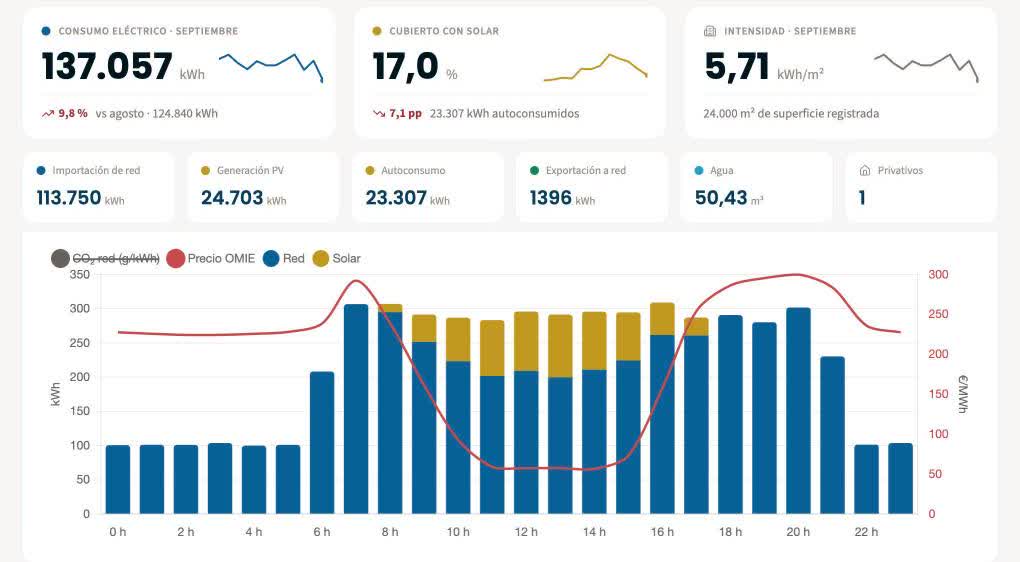
Today a building's energy data usually comes from one of these three sources. All three are useful, but each lacks something the directive asks for: logging, comparing and alerting.
It runs the installations, but often doesn't keep the history, compare buildings or allocate consumption by tenant. The Alfred platform gateway reads it and Metrics completes its data.
Someone downloads readings and reconciles them by hand. It works until a data point is missing or a meter is replaced. Metrics stores every reading in its period and our team checks every day that it arrives.
It gives twelve data points a year per supply, without knowing where the energy was used. Metrics measures by meter and by zone.
This is the median saving that Lawrence Berkeley National Laboratory measured in buildings that adopted energy information and fault detection systems. It is an external reference, not a Metrics result.
This is the estimate by eu.bac, the European association of building automation manufacturers, for control systems. It is an external reference, not a Metrics result.
Partly. Automation and control in non-residential buildings above 290 kW has been in the RITE since Royal Decree 178/2021. The rest of the directive had to be transposed by 29 May 2026 and, as of 13 November 2026, the Spanish legislation has not been published. Once published, it will set the final deadlines.
Not necessarily. The directive requires capabilities (recording, analysing, comparing, communicating), not a specific brand or system. If the building already has a BMS, the Alfred platform gateway reads it and Metrics completes its data; if not, it can be covered with meters and sensors.
We make use of it. A BMS runs the building systems, but often doesn't store history, compare buildings or separate consumption by use. Alfred adds those capabilities on top of the BMS you already have: the platform gateway reads it and Metrics stores, compares and allocates the data.
New homes and homes undergoing major renovation: the directive requires continuous electronic monitoring of their systems, from 29 May 2026, but in Spain it isn't mandatory until Spanish law incorporates it. The BACS obligation applies only to non-residential buildings.
Each Member State sets them when transposing the directive (Article 34). Until Spain publishes its legislation, there is no specific penalty regime for the new EPBD.
It depends on what the building already has. We'll tell you after reviewing its meters and its BMS.
If you advise owners on the EPBD or a certification, we give you the measured data and the reports for your client.
Metrics records, compares and reports the consumption of all your buildings, using what they already have. See how in Metrics.