Lights
Lighting that follows daylight
The more sun comes in, the fewer lights are on. Without touching a switch.
Energy, water, solar and EV charging for each warehouse in a single set of measured data: what tenants, funds and the EPBD ask for. We read what's already there, complete what's missing and keep the data up to date, with minimal infrastructure and without stopping operations.
Funds, developers and managers of warehouses and logistics parks: asset management, leasing, development and sustainability. And the BREEAM assessors who certify them.
Utilities are in the tenant's name and the owner cannot see consumption. The BMS, the solar PV, the EV charging and the meters each run separately, and a single replaced or wrongly programmed meter is enough to make the data worthless.
Measured, validated data, split by tenant and by end use, on a single dashboard for the whole portfolio: the basis for the EPBD, BREEAM In-Use, ESG reporting and due diligence with no open questions.
That it is delivered complete: metered, with the data accessible and without having to add anything later. And one already in operation can be completed without stopping operations.
HVAC, lighting and building services working, with accessible data.
Main meter and sub-meters: by unit, by tenant and by end use.
To spot anomalous consumption and allocate consumption.
Generation, self-consumption, import and export.
Charging energy, measured at its distribution board. Reading each charge point depends on the charger and is confirmed in each project.
Gatehouse, offices and shared areas: nothing left unmetered.
Article 13 of Directive (EU) 2024/1275 requires a building automation and control system (BACS) that continuously monitors, logs and analyses energy use, benchmarks efficiency, detects losses and alerts the person responsible, and communicates with equipment from any manufacturer.
The RITE (Royal Decree 178/2021) already requires that system in non-residential buildings with more than 290 kW of effective HVAC output. As a rough guide, 290 kW is an office building of 3,000 to 4,000 m².
The directive lowers the threshold to 70 kW by the end of 2029, adds indoor air quality and provides for rooftop solar, charging points in car parks and minimum energy performance standards for non-residential buildings. In Spain it will depend on transposition, which has not yet been published.
Metrics covers the measuring, logging, benchmarking and alerting; the BMS handles the adjustment of building services. Check in 10 seconds whether the EPBD affects you →
If the meter already exists, we read it. If not, we add an analyser or a radio meter, without stopping operations. We are manufacturer-agnostic.
Analysers on the main switchboard, in each unit and for each tenant.
From the BMS (BACnet, Modbus or KNX), via the Alfred gateway, or with an energy meter.
What the roof generates, what is self-consumed and what is bought from and sold to the grid.
With an analyser on the charging switchboard. Reading each charge point depends on the charger manufacturer and is confirmed on each project.
Incoming supply and secondary uses, with pulse or radio output.
Temperature, humidity and CO₂ in the offices and loading docks, with wireless sensors.
Equipment, installation, platform and data maintenance from a single supplier, from meter to report.
One warehouse or the whole portfolio on the same dashboard, with per-building access for each user.
Main, tenant and shared: what the tenant consumes and what the building consumes, which is what leasing teams and GRESB ask for. With an analyser per circuit, lighting, compressors and refrigeration too.
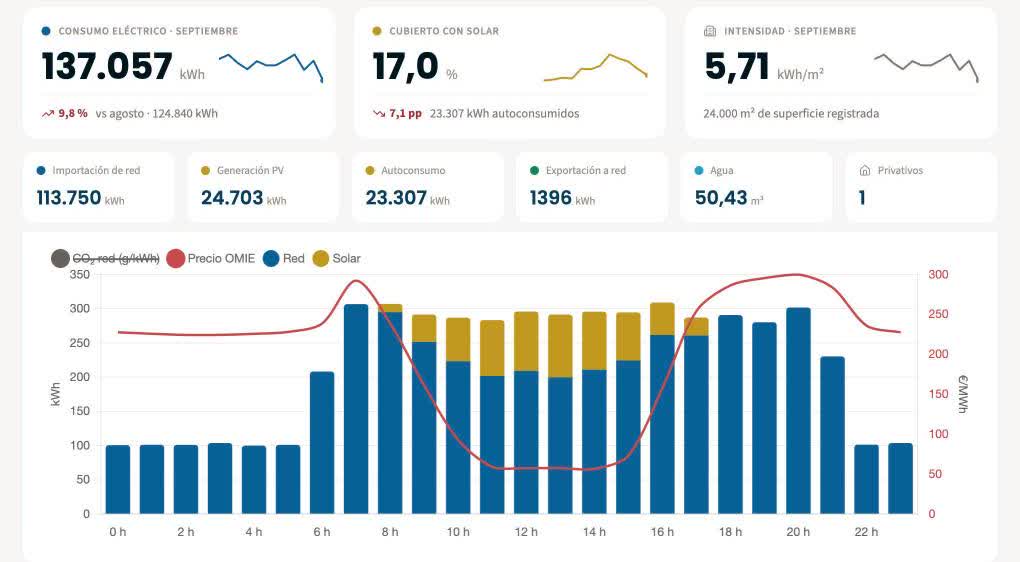
How much the solar PV covers, the cost of energy at each hour's price and the grid's CO₂ footprint hour by hour.
Night-time and weekend baseload, and threshold alarms sent by email: equipment left on while the warehouse is closed does not show up on a bill.
We separate the consumption of shared areas and of each tenant using the main meter and the sub-meters, without installing a meter in each unit or asking the tenant for access. That data covers the Part 1 monitoring and the Part 2 consumption data throughout the certificate's three years.
See BREEAM In-Use → · If you are a BREEAM assessor, here is how we work together →
Reporting platforms work with bills, supplier data and estimates: a bill gives twelve data points a year per supply. Metrics gives them the consumption measured in the warehouse, by meter, by tenant and by end use.
We don't replace it: we give it the measured data it currently receives as estimates, exported in Excel or CSV by period.
On its own, Metrics provides PDF and Excel reports, data export and alarms.
CRREM pathways, investment scenarios or the CSRD report: that is for your platform or your consultancy. We give them the data.
And the tenant sees their consumption and footprint, and the green clauses in the lease have something to be measured against.
Ideally a let warehouse that needs BREEAM In-Use certification or has to demonstrate EPBD compliance. It is then rolled out across the park.
There's no need to stop, and the infrastructure is minimal. Clamp-on analysers are fitted without cutting the supply, sensors are wireless and the gateway is installed on what's already there, with the warehouse running.
No. The Alfred gateway reads it via BACnet, Modbus or KNX, and we review it so that the data reaching Metrics is correct. The BMS still controls the building services. We confirm what can be read from each BMS during the technical visit.
No. For BREEAM In-Use we separate consumption using the main meter and the sub-meters, without installing a meter in each unit or asking tenants for access.
Today, if the HVAC exceeds 290 kW: the RITE already requires it. The rest of the directive will come with the Spanish transposition, which has not yet been published. The EPBD checker gives you an initial answer in a few seconds.
So that what you report is measured data, not estimates. Metrics doesn't compete with your platform: it gives it consumption by meter and by tenant, exported in Excel or CSV.
You assess and we generate the monitoring evidence. We explain it on the page for consultants and engineering firms.
Tell us how many warehouses you have and what you want to measure, certify or comply with, and we will choose the pilot warehouse together.